Skeleton Chariots are the pride of the Tomb Kings, gilded and lethal machines crewed even in death by Nehekhara’s finest warriors. Often fielded en masse, their rattling advance is heralded by clouds of dust, thrown high into the air as they thunder across the sands. Crashing into the enemy with bone-shattering force, these vehicles crush living bodies beneath their heavy wheels as their undead crew lay about the disorientated foe.
Tag: tomb kings
Skeleton Archers and Skeleton Warriors
The most numerous and fundamental units in the armies of the Tomb Kings of Khemri are the Skeleton Warriors and Archers. These soldiers were once the living legions of ancient Nehekhara, loyal footsoldiers who were entombed with their kings to continue their service in the afterlife. Now, centuries after the great ritual that cursed their land, they are reanimated by the incantations of Liche Priests, rising from their sandy graves in a tide of brittle bone and rusted weapons.
Though individually weak and lacking the martial prowess of their living counterparts, their true strength lies in their numbers and unwavering loyalty. They march in relentless, disciplined ranks, forming the unyielding core of the Tomb Kings’ army, serving as an anvil against which the foe is broken. The Skeleton Warriors, armed with spears or hand weapons and shields, are a formidable block of infantry, while the Skeleton Archers, with their warbows, provide a storm of arrows to harry and weaken the enemy from a distance.
The Battle of Matorea at Warhammer World
The Warhammer Old World diorama, “The Battle of Matorea,” is a breathtaking tableau that vividly brings to life a dramatic clash between the chivalrous Bretonnian Knights and the ancient, undead legions of the Tomb Kings of Khemri. This expertly crafted scene captures a pivotal moment in what must have been a desperate struggle, highlighting the contrasting aesthetics and fighting styles of these two iconic factions.
Settra the Imperishable lays siege to the coastal city of Matorea with a massive undead host as Cecil Gastonne, the Wyrm Slayer rallies its hopelessly outnumbered defenders. Just as the city’s defences begin to fail, the trumpeting of silver clarions sounds in the east, heralding the arrival of Duke Gastille. Have the duke and his knights arrived in time to lift the siege, or will they join the doomed defenders in a heroic death?
At the heart of the diorama, the Bretonnian Knights, resplendent in their vibrant heraldry and polished plate armor, are depicted mid-charge, lances lowered and banners flying high. The dynamism of their assault is palpable, conveying the sheer force and faith with which these champions of the Lady throw themselves into battle. One can almost hear the thundering hooves and the shouts of “For the Lady!” as they aim to shatter the brittle ranks of their skeletal foes. The diorama likely showcases various knightly orders, perhaps even a Duke or a Grail Knight, leading the charge with unwavering determination, their mounts rearing or galloping furiously into the fray.
Opposing this glorious charge, the Tomb Kings of Khemri present a stark and unsettling contrast. Their skeletal warriors, ancient and unfeeling, form an unyielding tide of bone and rusted bronze. Hierophants and Tomb Princes, perhaps astride macabre chariots or mighty constructs like Ushabti, would be strategically positioned, directing their automaton armies with an eerie, silent resolve. The diorama would no doubt emphasize the sheer numbers of the Tomb Kings, with ranks of skeleton warriors, archers, and perhaps even animated constructs like Screaming Skull Catapults or Necrolith Colossi, adding to the sense of overwhelming, relentless pressure. The bleached bones and dusty, tattered banners of Khemri create an atmosphere of dread and ancient power, starkly contrasting with the vibrant colours of Bretonnia.
“The Battle of Matorea” isn’t just a collection of miniatures; it’s a narrative frozen in time. The composition likely draws the viewer’s eye to key points of conflict – a Bretonnian Knight’s lance impaling a skeletal champion, a Foot Knight desperately defending a standard against a tide of mummified horrors, or a magical duel between a Bretonnian Damsel and a Liche Priest. Through meticulous detail and expert painting, the diorama effectively conveys the chaos, heroism, and horror of war in the Old World, making it a truly immersive and captivating piece for any Warhammer enthusiast. It serves as a testament to the rich lore and enduring appeal of the setting, particularly the epic conflicts that define its factions.
Khemrian Warsphinx
The Tomb Kings of Khemri of the Old World
The Tomb Kings of Khemri army in Warhammer: The Old World is a truly unique and visually striking force, embodying the ancient, desiccated might of a once-proud civilisation. Unlike the shambling, reanimated dead of the Vampire Counts, the Tomb Kings are not mindless zombies but rather the resurrected rulers and warriors of ancient Nehekhara, driven by the unwavering will of their mummified monarchs and the potent incantations of their Liche Priests. Their armies are a terrifying spectacle of bleached bone, rusted bronze, and an alien, ancient grandeur.
At the heart of every Tomb Kings army is the absolute authority of a Tomb King or Tomb Prince. These mummified rulers, often awakening with a renewed thirst for conquest, command their legions with a silent but absolute will. Their presence is vital, as the very cohesion and movement of the skeletal forces are tied to their magic. Alongside them stand the Liche Priests, the architects of the Tomb Kings’ unlife. These sorcerers of the Mortuary Cult wield the unique Lore of Nehekhara, which not only allows them to blast enemies with powerful curses and destructive magic but also to mend shattered bone and even re-animate fallen skeletons, ensuring the relentless advance of their army.
The rank and file of a Tomb Kings army consist of Skeleton Warriors and Skeleton Archers, seemingly endless hordes of reanimated soldiers from millennia past. While individually weak, their strength lies in their numbers and their terrifying resilience. Being undead, they are immune to psychology and cannot be broken by fear or casualties, simply crumbling away if too much damage is inflicted upon them. This allows them to form unyielding battle lines, holding back even the most ferocious charges through sheer weight of numbers. Supporting these infantry masses are the swift Skeleton Horsemen and Skeleton Horse Archers, providing mobile flanking forces or harassing fire. The thundering charges of Skeleton Chariots, crewed by skeletal warriors or even the elite Tomb Guard, deliver powerful impact hits and sow chaos in enemy ranks.
Beyond the basic skeletal legions, the Tomb Kings boast a terrifying array of monstrous constructs and elite animated guardians. The heavily armoured Tomb Guard, the sworn protectors of the kings in life and death, wield great weapons or halberds, forming unyielding elite infantry blocks. Towering Ushabti stalk the battlefield, colossal animated statues often armed with massive bows or great blades, capable of cleaving through entire units. More exotic horrors include the serpentine Sepulchral Stalkers that emerge from the sands to strike down foes, and the swift Necropolis Knights, fearsome riders atop giant, coiling constructs. For truly devastating blows, the Tomb Kings can field immense Necrolith Colossi or the terrifying Necrosphinxes, gargantuan constructs that embody the wrath of the ancient gods. Finally, the Screaming Skull Catapult hurls enchanted, flaming skulls that ignite the very air, spreading fear and destruction. The Tomb Kings army is a stark reminder of a glorious past, a relentless, unfeeling force that seeks to reclaim its ancient glory and sweep away the living empires that now stand upon the sands of their ancestral lands.
The Battle of Matorea
The Warhammer Old World diorama, “The Battle of Matorea,” is a breathtaking tableau that vividly brings to life a dramatic clash between the chivalrous Bretonnian Knights and the ancient, undead legions of the Tomb Kings of Khemri. This expertly crafted scene captures a pivotal moment in what must have been a desperate struggle, highlighting the contrasting aesthetics and fighting styles of these two iconic factions.
Settra the Imperishable lays siege to the coastal city of Matorea with a massive undead host as Cecil Gastonne, the Wyrm Slayer rallies its hopelessly outnumbered defenders. Just as the city’s defences begin to fail, the trumpeting of silver clarions sounds in the east, heralding the arrival of Duke Gastille. Have the duke and his knights arrived in time to lift the siege, or will they join the doomed defenders in a heroic death?
At the heart of the diorama, the Bretonnian Knights, resplendent in their vibrant heraldry and polished plate armor, are depicted mid-charge, lances lowered and banners flying high. The dynamism of their assault is palpable, conveying the sheer force and faith with which these champions of the Lady throw themselves into battle. One can almost hear the thundering hooves and the shouts of “For the Lady!” as they aim to shatter the brittle ranks of their skeletal foes. The diorama likely showcases various knightly orders, perhaps even a Duke or a Grail Knight, leading the charge with unwavering determination, their mounts rearing or galloping furiously into the fray.
Opposing this glorious charge, the Tomb Kings of Khemri present a stark and unsettling contrast. Their skeletal warriors, ancient and unfeeling, form an unyielding tide of bone and rusted bronze. Hierophants and Tomb Princes, perhaps astride macabre chariots or mighty constructs like Ushabti, would be strategically positioned, directing their automaton armies with an eerie, silent resolve. The diorama would no doubt emphasize the sheer numbers of the Tomb Kings, with ranks of skeleton warriors, archers, and perhaps even animated constructs like Screaming Skull Catapults or Necrolith Colossi, adding to the sense of overwhelming, relentless pressure. The bleached bones and dusty, tattered banners of Khemri create an atmosphere of dread and ancient power, starkly contrasting with the vibrant colours of Bretonnia.
“The Battle of Matorea” isn’t just a collection of miniatures; it’s a narrative frozen in time. The composition likely draws the viewer’s eye to key points of conflict – a Bretonnian Knight’s lance impaling a skeletal champion, a Foot Knight desperately defending a standard against a tide of mummified horrors, or a magical duel between a Bretonnian Damsel and a Liche Priest. Through meticulous detail and expert painting, the diorama effectively conveys the chaos, heroism, and horror of war in the Old World, making it a truly immersive and captivating piece for any Warhammer enthusiast. It serves as a testament to the rich lore and enduring appeal of the setting, particularly the epic conflicts that define its factions.
Old World Tomb Kings
These Old World Tomb Kings models were on display at Warhammer World.
A landscape cursed by the nefarious machinations of the dread necromancer Nagash, the realm of Nehekhara, once known as the Great Land thanks to its long enduring prosperity, is now the domain of the dead. This accursed land is ruled over by the ancient Tomb Kings and their legions of dread skeletal warriors.This supplement takes an in-depth look at the Land of the Dead, exploring the traditions and beliefs of this horrifying realm of cadaverous kings and their skeletal subjects.
The Battle of Matorea
This diorama is one of the newest displays at Warhammer World. This is a Warhammer Old World diorama and shows The Battle of Matorea. A massive conflict between the undead Tomb Kings of Khemri and the valiant Kingdom of Bretonnia.
Settra the Imperishable lays siege to the coastal city of Matorea with a massive undead host as Cecil Gastonne, the Wyrm Slayer rallies its hopelessly outnumbered defenders. Just as the city’s defences begin to fail, the trumpeting of silver clarions sounds in the east, heralding the arrival of Duke Gastille. Have the duke and his knights arrived in time to lift the siege, or will they join the doomed defenders in a heroic death?
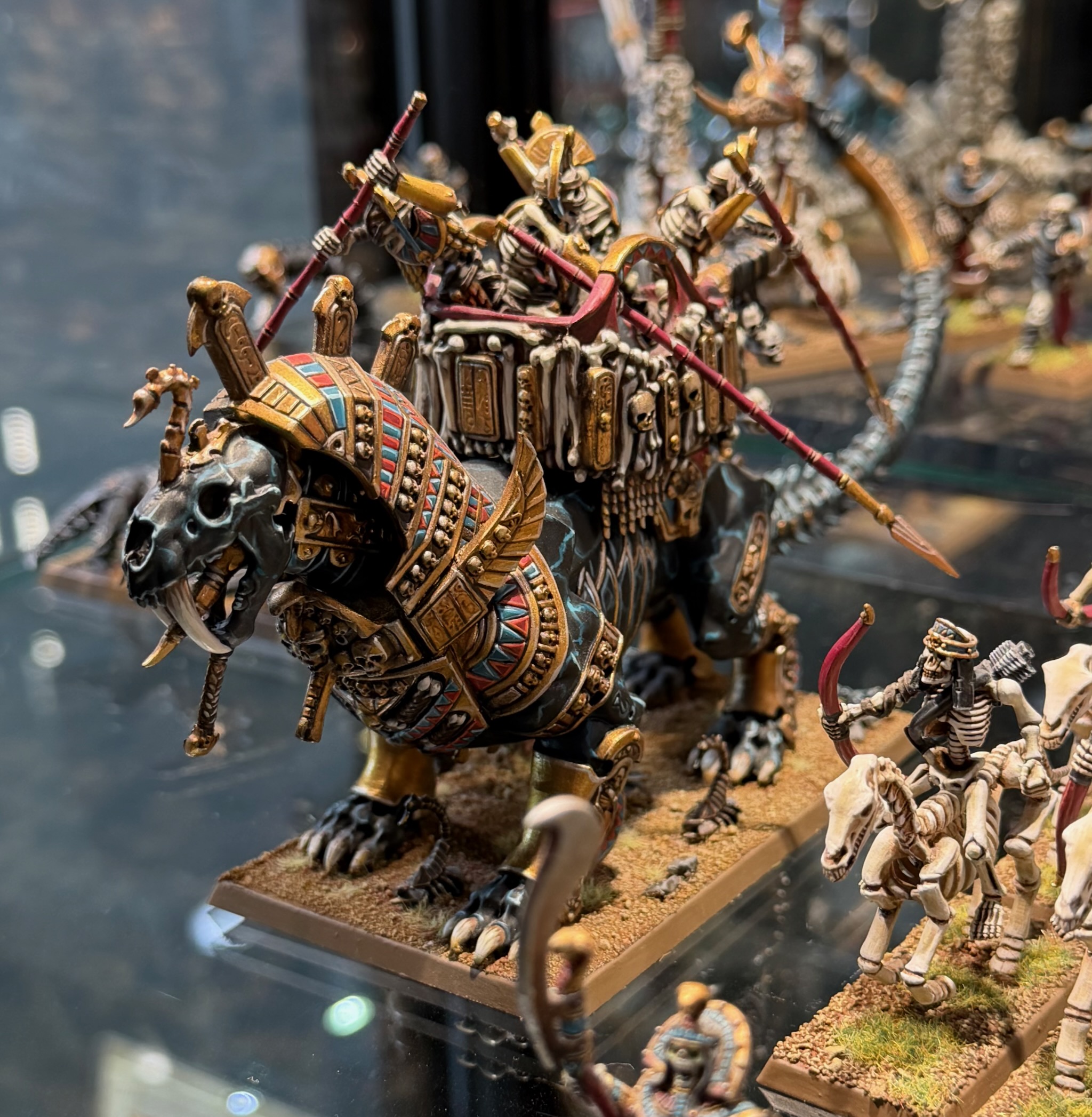
Khemrian Warsphinx
Liche Priest on Necrolith Bone Dragon
This Liche Priest on Necrolith Bone Dragon was in the display cabinets at Warhammer World.

Only the most prestigious priests can harness the undying will of a fearsome Necrolith Bone Dragon, much less ride such a behemoth into battle. These reanimated wyrms descend upon the living, given unnatural flight by skeletal wings, before lashing out with wicked claws and jagged fangs. Those who survive must contend with clouds of seething dust and desiccating smog, for a dragon’s breath is lethal even in death.