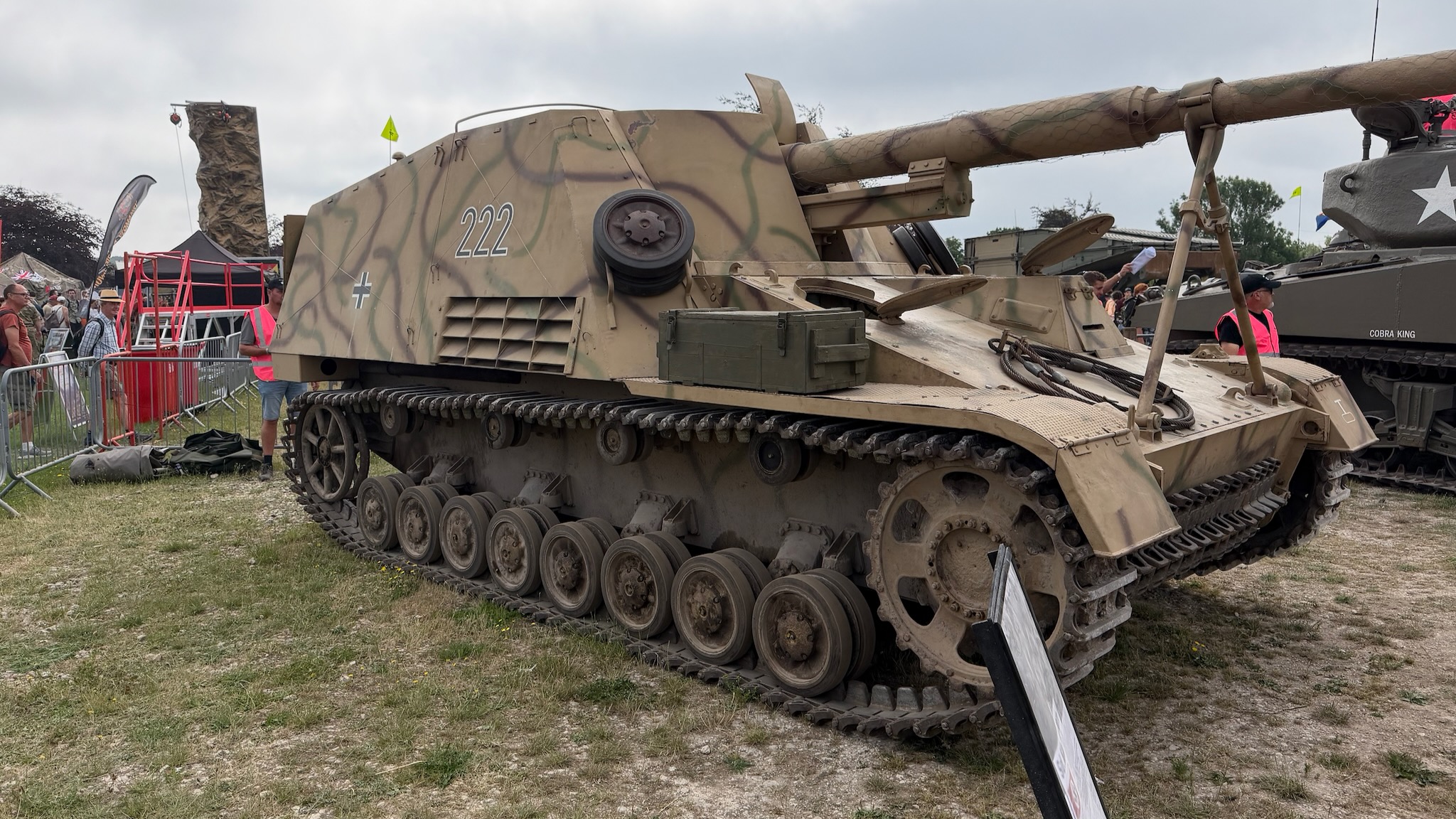
Nashorn Tank Destroyer

This Nashorn Tank Destroyer was taking part in Tankfest 26 at The Tank Museum.

The Nashorn (German for “Rhinoceros”) was a formidable German tank destroyer developed in 1942 as an interim solution to counter heavily armoured Soviet T-34 and KV tanks.

Built on the specialised Geschützwagen III/IV hybrid chassis, which combined elements of both the Panzer III and Panzer IV medium tanks, it mated a highly mobile tracked platform with the devastating 8.8 cm Pak 43/1 anti-tank gun.

This weapon was one of the most lethal anti-tank guns of World War II, capable of penetrating the armour of almost any Allied or Soviet vehicle at extreme ranges, often well before the enemy could close the distance to fire back.
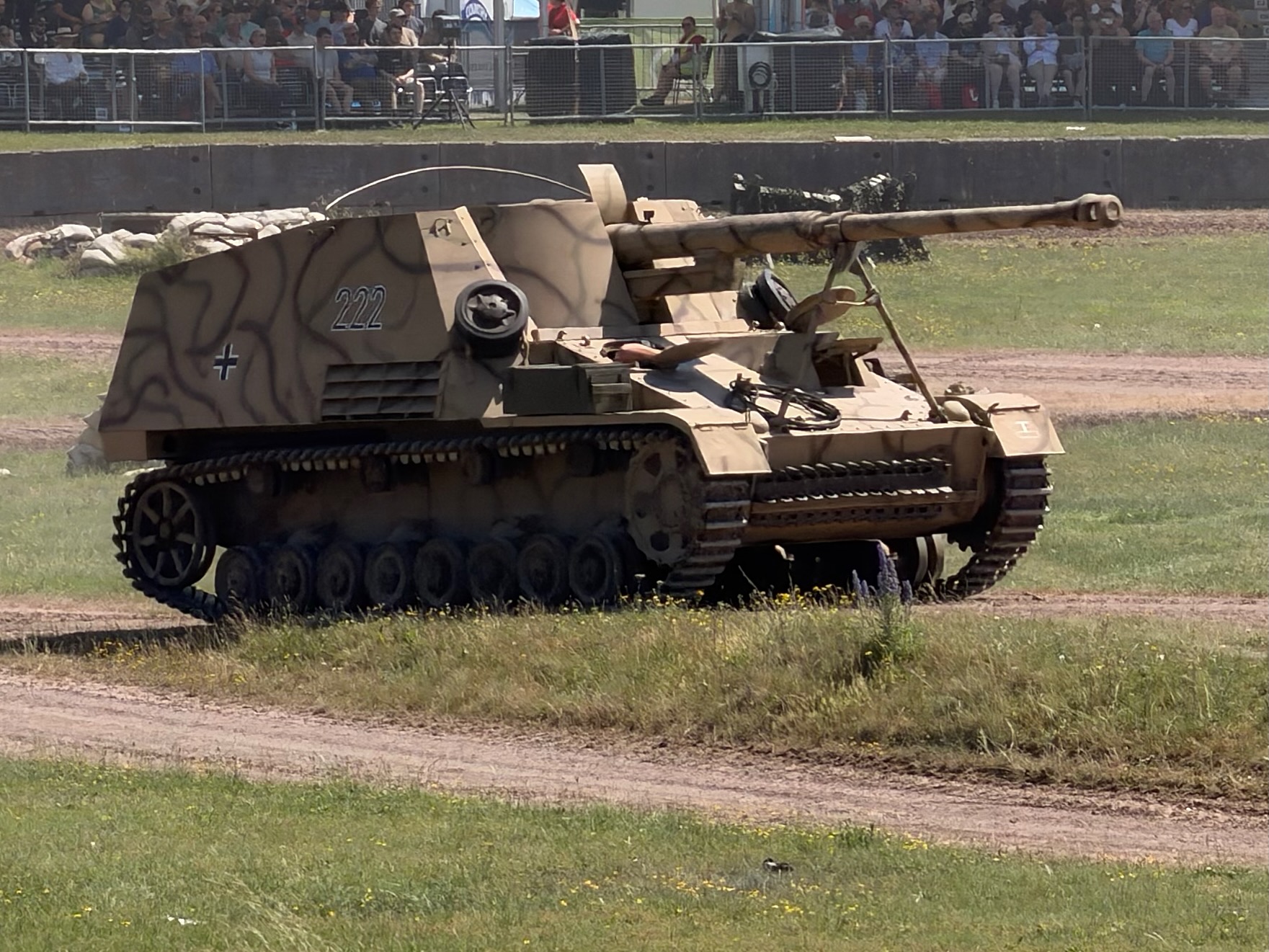
However, to offset the immense weight of the 8.8 cm gun and maintain mobility, the Nashorn was designed with a tall, open-topped, and lightly armoured superstructure.

With only 10 mm of armour protection on its gun shield and sides, the crew was highly vulnerable to artillery fragments, small arms fire, and air bursts. Consequently, the Nashorn had to be operated strictly as a long-range sniper from concealed positions, utilising its exceptional gun optics and ballistics to strike from afar rather than engaging in close-quarters armoured brawls.
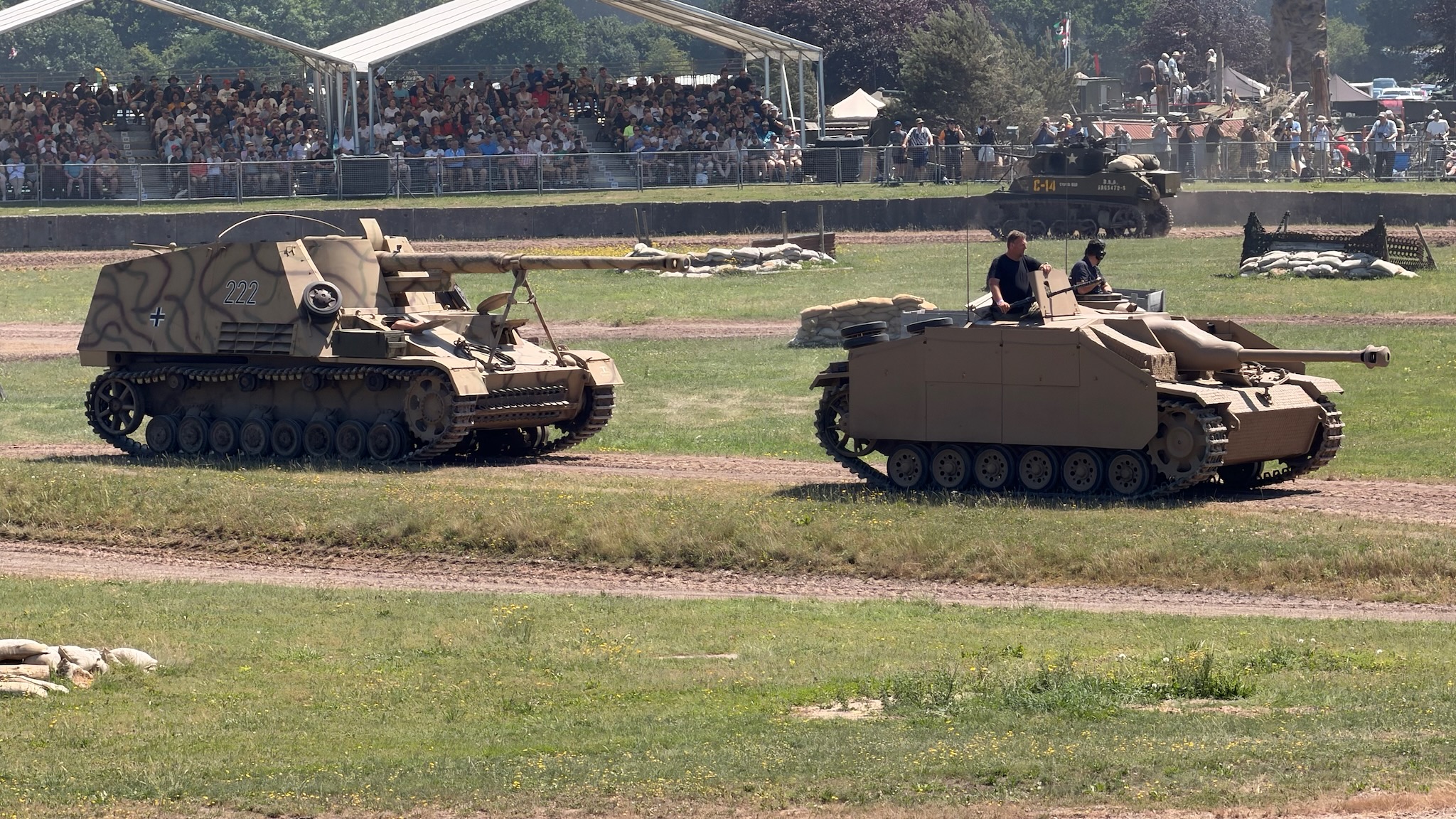
This is a privately owned Nashorn with the hull serial number 310163 and was restored to running condition in the Netherlands.
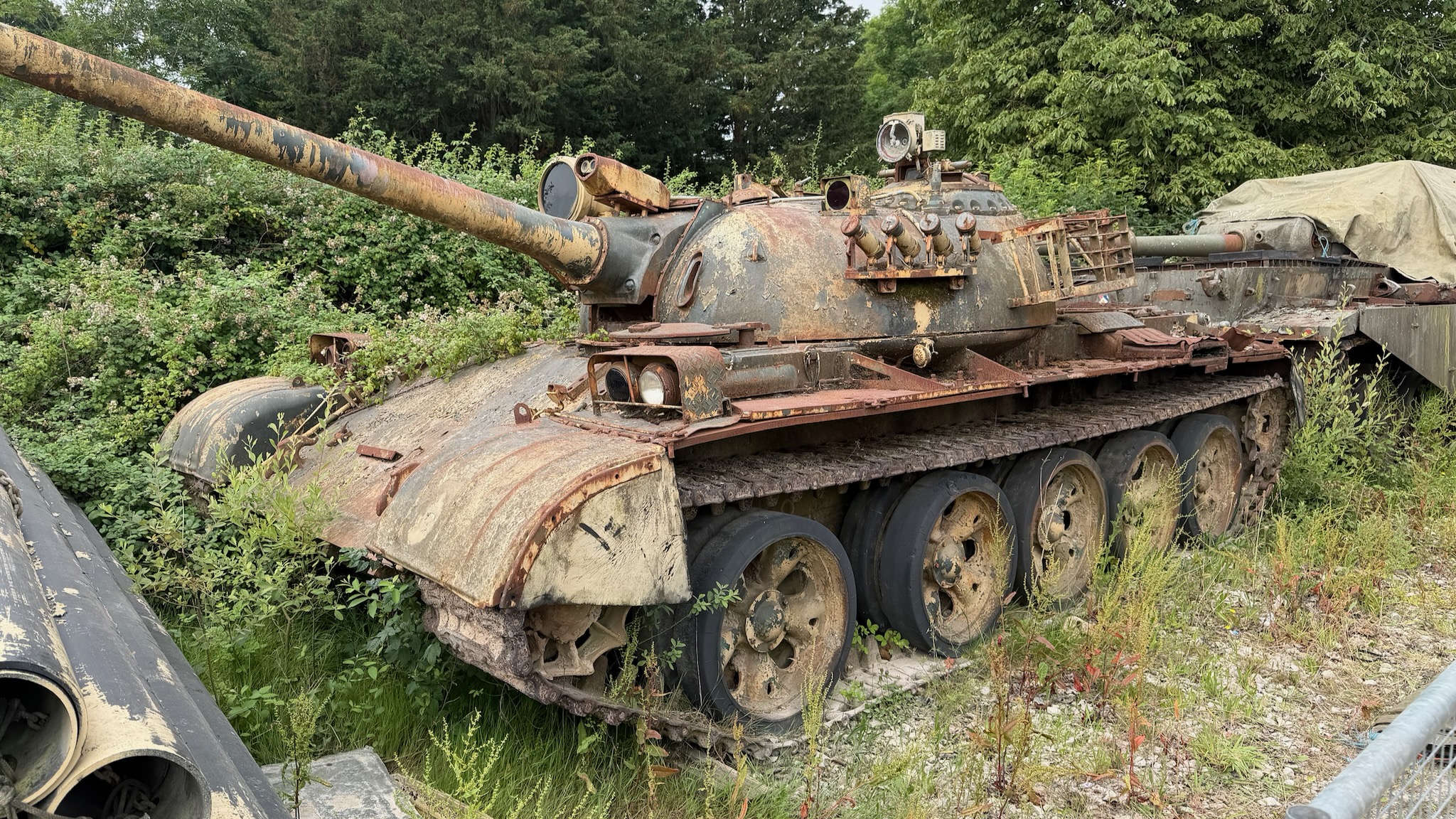
Iraqi T55 Tank

These rusty Iraqi T-55 tanks were next to the Tank Park at Tankfest 26 at the Tank Museum.

The T-55 is a series of Soviet-era medium tanks that were introduced shortly after World War II. It is one of the most widely produced tanks in history, with over 100,000 units built in the Soviet Union and under license in Poland and Czechoslovakia. The T-55, along with its predecessor the T-54, became the backbone of armoured forces for the Warsaw Pact and many other nations.

The tank featured a low-slung, compact design with a cast, dome-shaped turret and was armed with a 100mm rifled gun. While it was considered advanced for its time, its design was later outmatched by more modern tanks. However, its simple, rugged, and reliable nature has allowed it to remain in service with various armed forces worldwide, often with significant upgrades.

Operation Unthinkable T55 Tanks on the workbench.

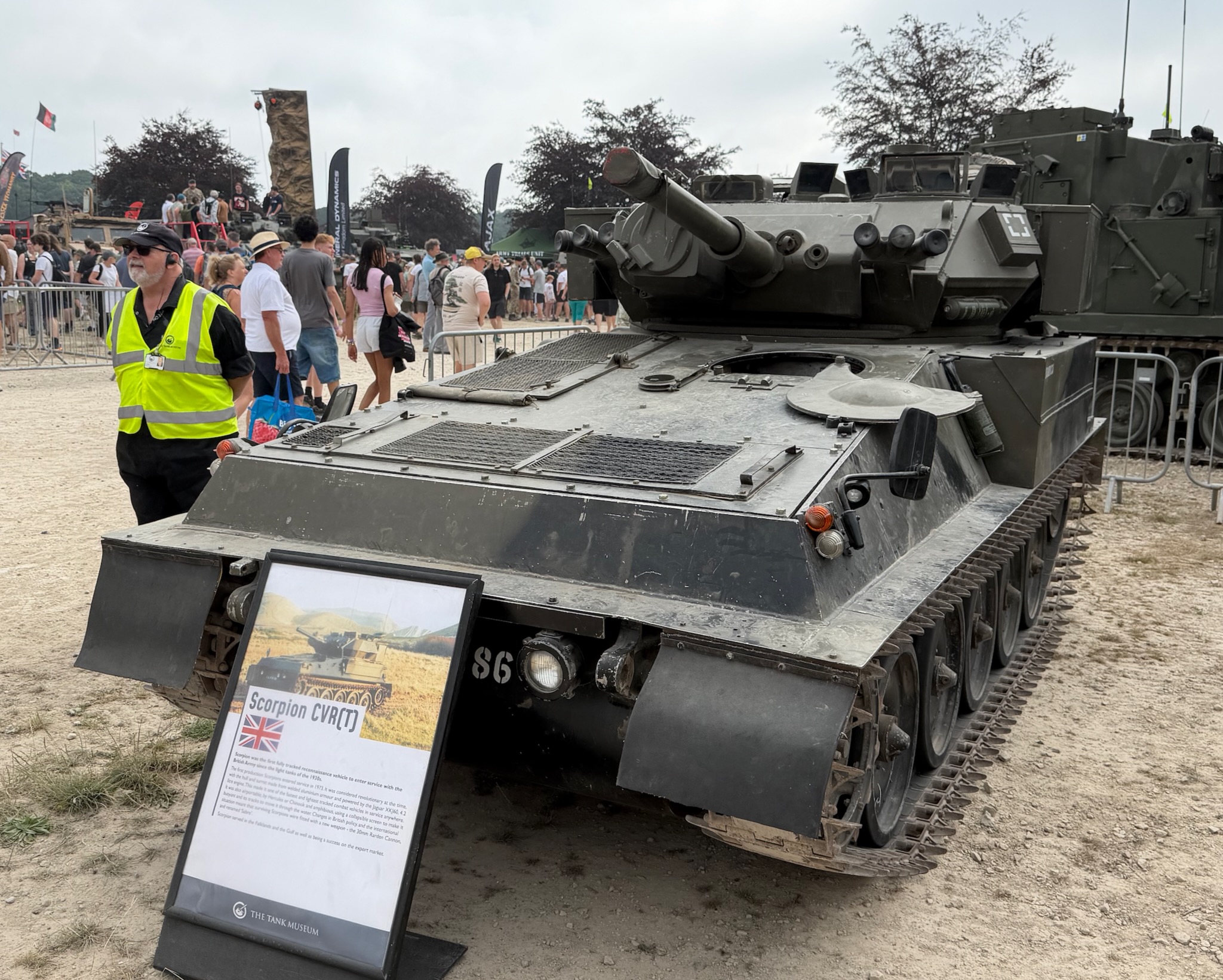
FV101 Scorpion CVRT at Tankfest

The Scorpion Combat Vehicle Reconnaissance (tracked) FV101 was at Bovington. Though most people would call it a light tank.

The FV101 Scorpion is a British armoured reconnaissance vehicle. It was the lead vehicle and the fire support type in the Combat Vehicle Reconnaissance (Tracked), CVR(T), family of seven armoured vehicles. Manufactured by Alvis, it was introduced into service with the British Army in 1973 and served until 1994.

Scorpion became the first of a whole family of fighting vehicles including Scimitar, Striker and Samaritan. It served in the Falklands and the Gulf as well as being a success on the export market. Changes in British policy, and the international situation meant that surviving Scorpions were fitted with a new weapon, the 30mm Rarden Cannon, and renamed Sabre.

It has been supplied to Belgium, the Irish Republic, Malaya, New Zealand, Nigeria, Oman and Venezuela.

I have some Team Yankee Scorpions, they are currently in the process of being painted as BAOR versions.

Some thoughts on the RAF Regiment Scorpion I saw at RAF Cosford.

BRDM 2 Scout Car

This BRDM 2 Scout Car was at Tankfest 26. The BRDM-2 is a Cold War-era Soviet amphibious armoured scout car designed to replace the earlier BRDM-1. Introduced in the early 1960s, the 4×4 vehicle was specifically engineered for high mobility and stealthy reconnaissance. Unlike its predecessor, which featured open-top or flush-mounted weapons, the BRDM-2 was equipped with a fully enclosed, manually operated turret housing a potent 14.5mm KPVT heavy machine gun and a coaxial 7.62mm PKT general-purpose machine gun.

Powered by a rear-mounted 140-horsepower GAZ-41 V8 gasoline engine, the 7-ton vehicle can hit speeds of up to 100 km/h on paved roads. One of its most distinctive engineering traits is its off-road capability: in addition to a centralised tire-pressure regulation system, it features two pairs of auxiliary, chain-driven belly wheels that can be lowered hydraulically by the driver to help the vehicle crawl over wide trenches, ditches, and steep obstacles. With its fully amphibious hull propelled by a single rear water-jet, an overpressure collective NBC (nuclear, biological, and chemical) protection system, and infrared night-driving equipment, the BRDM-2 became a ubiquitous scouting asset produced in the thousands and exported to dozens of nations worldwide.

Citroën U23 Light Truck

This Citroën U23 Light Truck in German camouflage was part of Tankfest 26.

The Citroën U23 (or Type 23) successfully bridged the gap between passenger car elegance and workhorse utility. By marrying the distinctive, swept-back front grille and wings of the revolutionary Traction Avant with a conventional, rugged rear-wheel-drive chassis, Citroën created an instantly recognisable aesthetic that defined French roads for decades. Originally powered by the same dependable 1.9-litre four-cylinder engine found in the Traction Avant, the 2-ton truck proved to be incredibly versatile, serving as everything from open flatbeds and enclosed vans to city buses. Its durability became a vital asset during World War II, during which it was heavily utilised by the French military and subsequently requisitioned in large numbers by German forces. Remaining in production for over thirty years until 1969 the U23 cemented its legacy as one of the most enduring and beloved backbones of mid-century European transport.

British Vickers Light Tank Mk IV

British Vickers Light Tank Mk IV

T1344 is a surviving British Vickers Light Tank Mk IV, currently housed in the reserve collection at The Tank Museum in Bovington, Dorset, UK. Built in March 1935 at the Elswick Works in Newcastle-upon-Tyne, it features the original War Department registration number T1344 painted on its left hull side alongside the military census number. The tank was running at Tankfest 26.

M24 Chaffee Tanks

M24 Chaffee

There were two M24 Chaffee tanks on display at the Bovington Tank Museum for Tankfest 26 and both were part of the displays in the arena.

M24 Chaffee

The Light Tank M24 was an American light tank used during World War II and in postwar conflicts including the Korean War and with the French in the First Indochina War and war in Algeria.

M24 Chaffee

In British service it was given the service name Chaffee, after the United States Army General Chaffee, Jr, who helped develop the use of tanks in the United States armed forces.

Kettenkrad SdKfz 2

This Kettenkrad was on display at the Bovington Tank Museum for Tankfest 26 and did make it to the arena.

Kettenkrad SdKfz 2

The Kettenkrad SdKfz 2 started its life as a light tractor for airborne troops. The vehicle was designed to be delivered by Junkers Ju 52 aircraft, though not by parachute. The vehicle had the advantage of being the only gun tractor small enough to fit inside the hold of the Ju 52, and was the lightest mass-produced German military vehicle to use the complex Schachtellaufwerk overlapped and interleaved road wheels used on almost all German military half-tracked vehicles of World War II.


Light Tank M5A1 Stuart

The “Cisco Kid” is a famous, fully restored M5A1 Stuart light tank. It was used by the U.S. Army during World War II.

Light Tank M5A1 Stuart

It took part in Tankfest 26 at The Tank Museum.

The M3 Stuart, officially Light Tank, M3, was an American light tank of World War II. An improved version entered service as M5. It was supplied to British and other Commonwealth forces under lend-lease prior to the entry of the U.S. into the war. 

Fury at Tankfest 26

This Sherman tank is the star of the film Fury and was one of the stars of the Tank Museum’s Talkfest 26.

A M4A3E8 Sherman was used by the film makers and Bovington have kept the Sherman tank as it was in the film, complete with weathering, props and the name Fury painted on the barrel of the main weapon. TheM4A3E8 Sherman has much wider tracks than other Shermans and this makes the tank look much taller and bigger than other Sherman tanks.

Most of the film was shot in Oxfordshire (and not Germany). The German town used in the film was built completely from scratch, which isn’t too surprising considering what happens there.

I really enjoyed the film and thought a powerful interpretation of the last few months of the war and the defiant last stand by the Germans despite knowing they faced eventual defeat, with the Americans wanting to finish quickly so they can go home. It has to be said that the end of the film leaves something to be desired, but remember this is Hollywood.

Get Fury on 4K Blu Ray from Amazon.